Home / Sunday-mid-day / Article /
Why are parents sending kids to illegal schools?
Updated On: 20 August, 2023 06:26 AM IST | Mumbai | Dipti Singh
The BMC’s crackdown on schools not recognised by the education department begs the question, why has a robust ecosystem of alternative education mushroomed in the first place





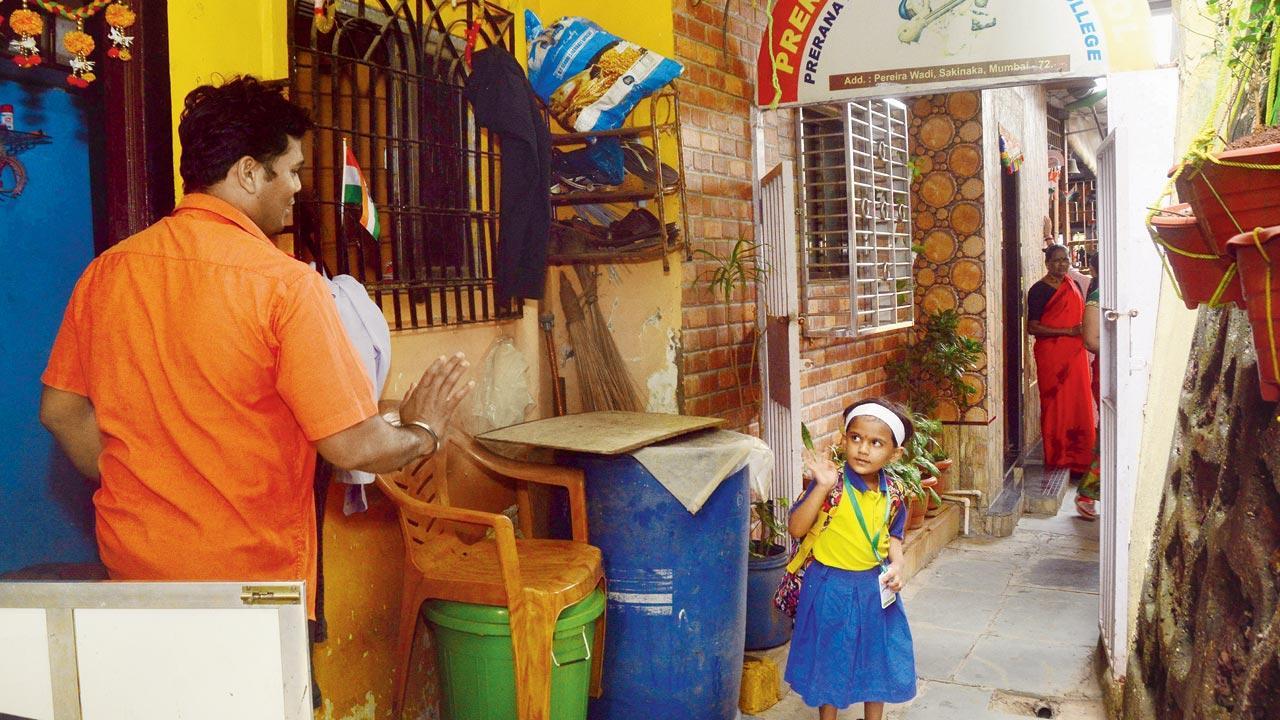
A young girl studying at Prerna English School, situated inside a slum pocket in Sakinaka, heads to school next door. While the school has been declared unauthorised by the state government, most parents prefer sending their kids here, because of its affordable fees and proximity to home. Pic/Satej Shinde
A stone's throw away from the Deonar landfill is the VK English School in the thick slum settlement of Bainganwadi, where 400-odd students jostle for space inside crammed classrooms. The school, comprising a ground-plus-two structure and another single-storey building, has 19 classrooms in all. Skirting it are garages, hardware repair shops, shanties, and even a beedi shop. The Govandi school could easily be mistaken for a two-storey shanty, if it weren’t for the board flashing its name. Shabana Khan Academy, a registered nonprofit trust, manages the school.
For an outsider, it might not be the best spot to situate a school, but for the residents of the slum, the school has been a blessing in disguise, allowing their children a rare opportunity to receive affordable English education.
Trending Stories
Latest Photos
Latest Videos
Latest Web Stories
ADVERTISEMENT

Ganeshotsav 2026

ADVERTISEMENT