






Home / Sunday-mid-day / / Article /
‘Why should we believe the government now?’, say ASHA workers
Updated On: 27 June, 2021 08:55 AM IST | Mumbai | Prutha Bhosle
Failed promises, low pay and manifold challenges for one of the first responders to help India fight Covid-19 mean that the 70,000 Accredited Social Health Activists (ASHA) workers of Maharashtra are a disillusioned lot

Listen to this article :
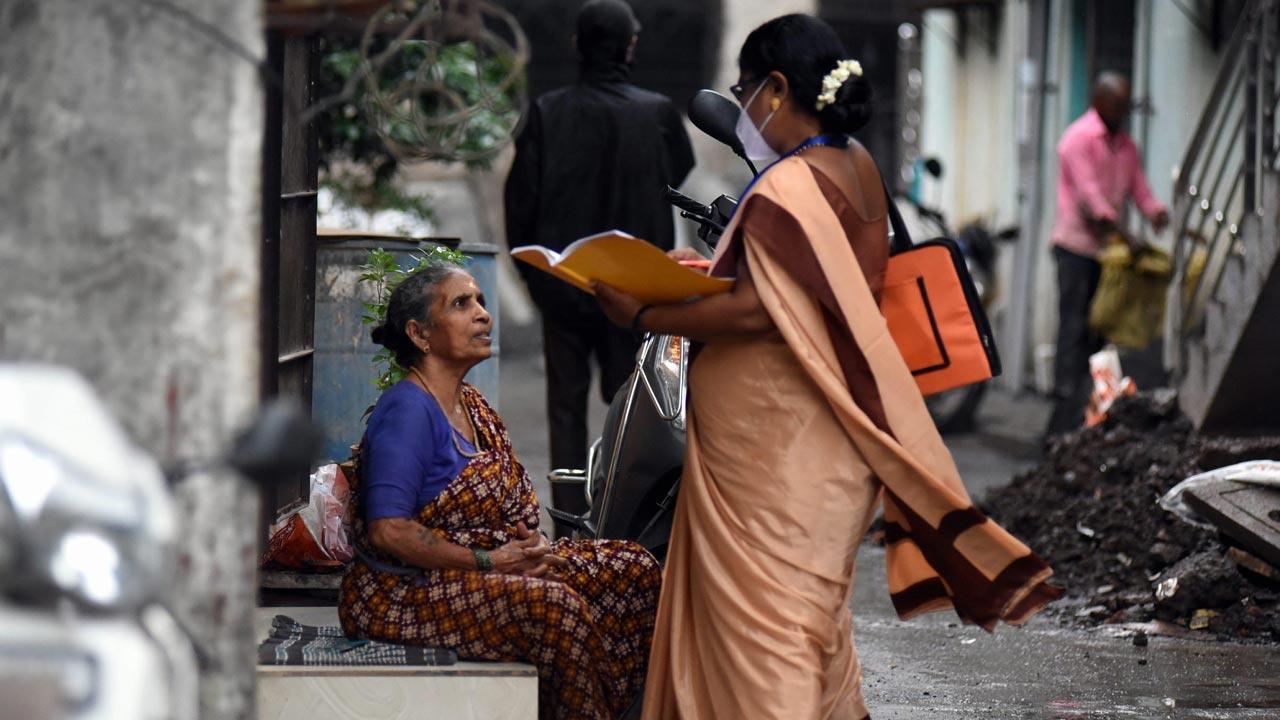
Ganga Lande didn’t want to venture out and become the carrier of the virus when lockdown was imposed last year. She didn’t leave her home, until she was promised a PPE kit, mask and gloves to do surveys in Ulhasnagar. Pics/Sameer Markande
Not many residents of the villages in Palghar district know Bhakti Kini’s last name. For them, she is Bhakti tai, the woman who hikes up a hilly neighbourhood in Kore, Saphale, every day. Her reward? Rs 6,000 a month. Kini, 50, an ASHA worker, walks and climbs 3 km daily to reach the healthcare centre, where she is assigned the duty of monitoring the health of local residents. She starts her shift at 9 am after finishing household chores. Her 30-year-old daughter and 16-year-old son help her around the house. Kini’s husband, who worked at Boisar’s Brinks Arya Company and has been out of a job for three years, is not of much use, she admits, making her the sole breadearner of a four-member family. “I could take an autorickshaw, but that would cost me R50 one way. I can’t afford it,” Kini says in an interview to mid-day on a day when she has been deployed to immunise people for Covid-19.
Called the Independent Panel for Pandemic Preparedness and Responses (IPPPR), a report established by World Health Organization (WHO) in January 2021, highlighted how the deployment of “a cadre of million women social health activists” has helped India’s Covid-19 surveillance. “Community engagement by ASHA workers has been a successful strategy in enhancing India’s national response to Covid-19,” it stated, adding, “Systems for health require substantive community engagement at every step of pandemic preparedness and response, from early detection and alarm to the dissemination of reliable information throughout a community, including effective ways to prevent, care for and treat infection.”
Read Next Story
Trending Stories
Latest Photos
Latest Videos
Latest Web Stories
ADVERTISEMENT
Mid-Day Fast
ADVERTISEMENT

ADVERTISEMENT