






He cares a ‘hoot’
Updated On: 01 August, 2021 06:55 AM IST | Mumbai | Sumedha Raikar Mhatre
The endangered and elusive forest owlet is the protagonist in an ornithologist’s new book that celebrates the rediscovered stocky unspotted diurnal owl, endemic to Melghat and other forests

Listen to this article :
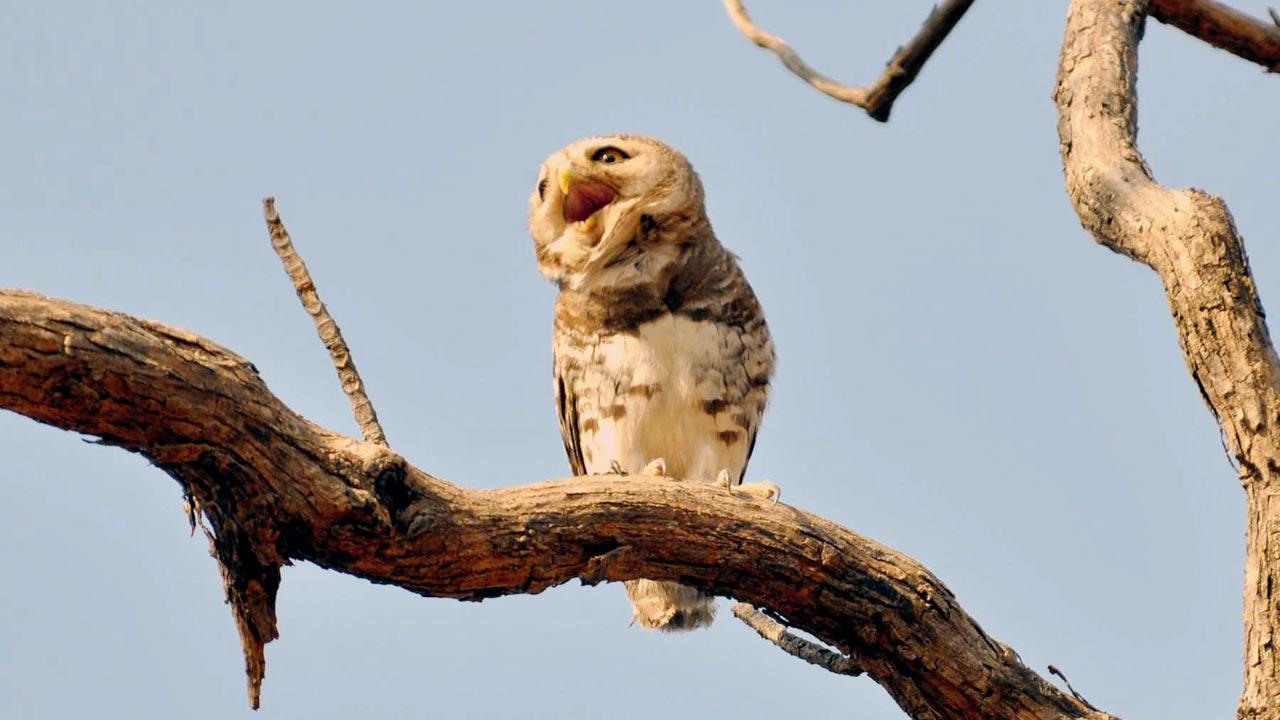
The forest owlet, known as Dongar Duda locally, can only grow in numbers, if trees in the Satpudas in Central India are protected. Pic courtesy/Dr Gajanan Wagh
 After Maharashtra’s first tiger conservation project was launched in the biodiverse Melghat mountainous region in 1973, celebrated ornithologist Dr Salim Ali camped for 10 days in some of its remotest corners. One guest-book entry in the Kolkas circuit house stands testimony to his stay; local bird watchers recall his specific interest in the near-extinct forest owlet, a species endemic to Melghat and other forests of the Satpuda range in Central India. Dr Ali left without spotting the diurnal owl, but he strongly believed that the missing species was not terminated. He said an additional set of eyes will bring success to the search. His belief was validated by the rediscovery of the species in 1997 by American expert Dr Pamela Rasmussen in Shahada in the Nandurbar district. The rediscovery made global news; it elated not just zoologists, but also citizens who lived in the Melghat region. They experienced a sense of ownership and pride in the company of forest owlets—now over 250 in Melghat of the total 1,000—with special daytime mobility.
No wonder that an ornithologist, born and raised in Melghat, Dr Jayant Wadatkar, has captured the bird’s exile and its dramatic re-entry, in a new book, Raanpingla: Adnyatvaas va Punarshodh (Forest Owlet: The Exile and The Rediscovery). The Amravati-based expert has been part of many self-driven expeditions—two funded by Birdlife International UK and Raptor Research Conservation Foundation Mumbai—post 2000, in Maharashtra, Madhya Pradesh and Gujarat to study the nesting, breeding, and resting behaviour of the rediscovered owl. His Marathi book, soon to be rendered in English and in an online avatar, celebrates the Raanpingla (forest owl), which brought international attention to a region essentially characterised by the Bengal tiger.
Read Next Story
Trending Stories
Latest Photos
Latest Videos
Latest Web Stories
ADVERTISEMENT
Mid-Day Fast
ADVERTISEMENT

ADVERTISEMENT