Home / Sunday-mid-day / Article /
Same field. Different lands
Updated On: 05 December, 2021 08:15 AM IST | Mumbai | Jane Borges
A Pakistani couple whose recent exhibition documents Indo-Pak’s shared pre-partition heritage, makes sense of the invisible fault lines that separate the countries





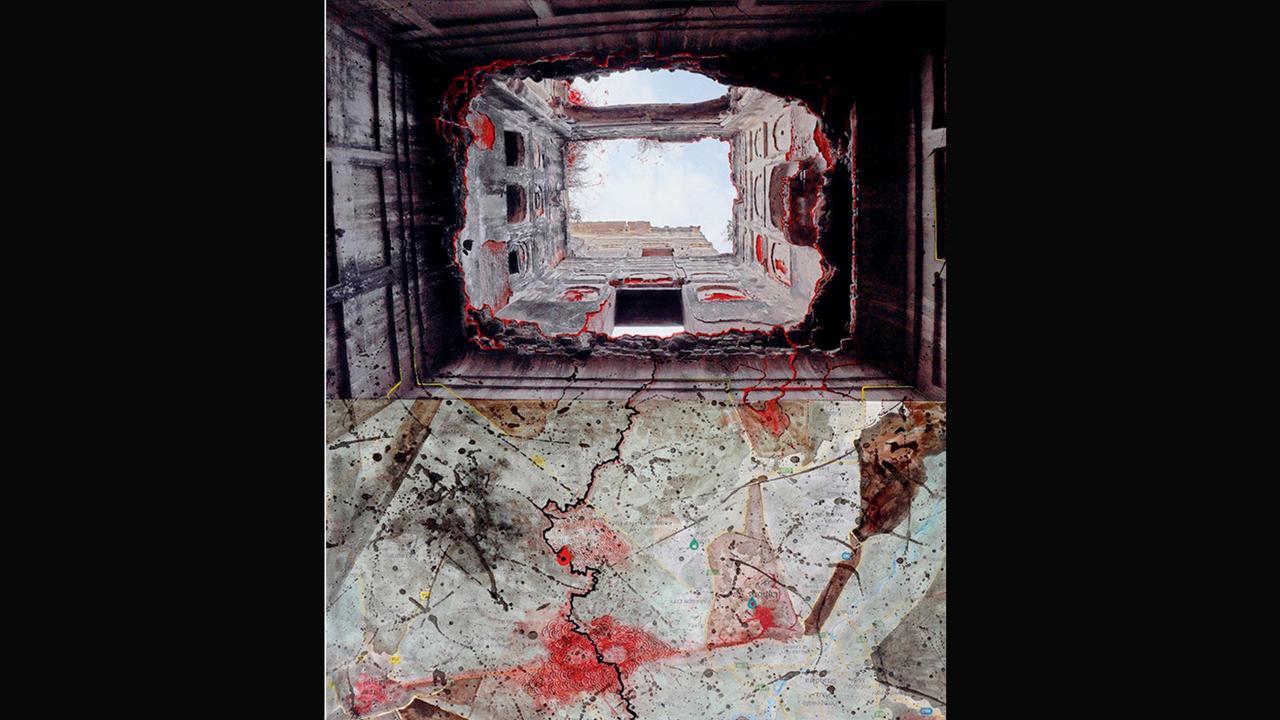
Maria’s photograph, nominated for the Sovereign Asian Art Prize 2021, shows a pre-partition haveli on the Indo-Pak border of Punjab province in Pakistan
Architect-photographer Maria Waseem grew up on the other side of Punjab. It wasn’t India, but had remnants of it, with a shared border—the presence of which her nani spent most of her life vexing about. “She had a lot of Hindu friends who moved to India after the Partition. That loss stayed with her forever. In the later years of her life, when she was afflicted by a mental health illness, she’d only talk about India. In those days [the 1980s], Punjab [province of Pakistan] would see Doordarshan air on its television network. I remember nani watching Chitrahaar and Mahabharat. For some reason, she was stuck in pre-Partition, and never came out of it,” says Lahore-based Maria ruefully, over a telephone call. Her husband, noted miniature painter and visual artist Waseem Ahmed, who has joined us on the call, and also has roots in India, shares the story of his family. “My nana and nani lived in Ajmer before the Partition. While nani loved Pakistan, my nana never reconciled with the loss. He had to leave everything, including his home and a secure job in the railways. He was so hurt, he never went back to India. But, I grew up listening to stories about Ajmer, and it felt like I knew the place by rote. I had created a blueprint in my mind. When I visited Ajmer for this first time in 2007, it felt like I had always lived there.”
Although the couple admits to not having witnessed the scars of the Partition first-hand, living with these stories has seen them make sense of the pain and wounds that run deep. Their recent exhibition, Till Death Do Us Part at the Sanat Initiative in Karachi, explores the pre-partition architectural history and landscape of both countries, and the borders that divide them. While Maria’s photographs take us through abandoned structures, religious buildings, and the shared tracts of land, valleys and blue sky, Waseem interjects his painterly marks on these images, showing foliage, splashes, streaks, lines, cracks and walls, otherwise invisible to the naked eye.
Trending Stories
Latest Photos
Latest Videos
Latest Web Stories
ADVERTISEMENT

Ganeshotsav 2026

ADVERTISEMENT